Treatments / Injection Therapy
Injection Therapy
We offer two forms of injectable treatment — corticosteroid injections for inflammation-driven pain, and Ostenil (hyaluronic acid) injections for joint degeneration and osteoarthritis. Both are administered by our HCPC-registered podiatrists and complement your wider management plan.
Injectable treatments allow us to deliver therapeutic agents precisely to the site of pain, bypassing the limitations of oral medication and topical therapies. The choice between a corticosteroid and an Ostenil (hyaluronic acid) injection depends on the underlying diagnosis — specifically, whether the primary driver is acute inflammation or joint degeneration and poor lubrication.
Your podiatrist will recommend the appropriate injection type at your consultation, or in some cases a staged approach using both. Both options are available at our Richmond and Kensington clinics.
Option 01
Corticosteroid Injections
Potent anti-inflammatory. Best for tendinopathy, bursitis, fasciitis and nerve pain. From £125.
Option 02
Ostenil (Hyaluronic Acid)
Joint lubricant and cartilage support. Best for osteoarthritis and degenerative joint conditions. From £85 per joint / course of 3 from £225.
What it is
Corticosteroid injections contain a synthetic version of cortisol — a natural hormone produced by the adrenal gland with a potent anti-inflammatory effect. When injected directly into or around the affected structure, they rapidly suppress localised inflammation, reducing pain, swelling and tissue irritability. They can be delivered into joints, tendon sheaths, bursae, ligaments or around nerves.
Conditions we treat
Plantar fasciitis & heel pain
Tendinopathy & tendonitis
Arthritis (various joints)
Benefits
01
Fast-acting. Effects are typically felt within 48–72 hours and peak at around 2 weeks — significantly faster than oral medication.
02
Targeted. Delivered directly to the source of pain, minimising systemic exposure compared to oral steroids.
03
Facilitates rehabilitation. Pain relief creates a window for loading and rehabilitation that would otherwise be too painful to progress.
04
Improved mobility. Reduced inflammation restores joint and soft tissue range of motion, supporting return to normal activity.
Important considerations
Corticosteroid injections are most effective when used as part of a broader management plan — not as a standalone treatment. Repeated injections into the same site are generally limited to 3 per year due to the risk of tissue weakening over time. Your podiatrist will discuss frequency, timing and any relevant contraindications (including diabetes, anticoagulants and recent infection) at consultation.
A period of relative rest for 24–48 hours post-injection is advised to allow the injection to settle, after which a structured rehabilitation programme typically begins.
What it is
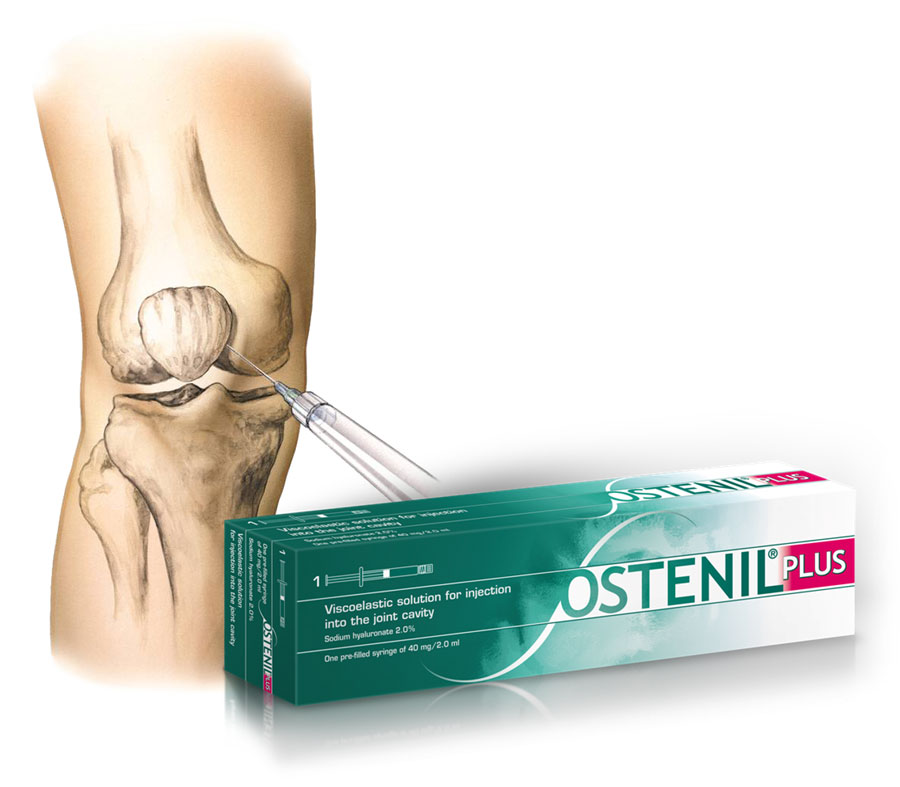
Ostenil Plus is a viscosupplementation injection containing a high concentration of sodium hyaluronate (hyaluronic acid) — a substance naturally present in healthy synovial fluid. In osteoarthritic joints, this fluid becomes thinner and less effective as a lubricant. Ostenil Plus restores its viscoelastic properties, reducing friction, protecting cartilage and improving joint function.
We use Ostenil Plus — the higher-concentration formulation that also contains mannitol as an antioxidant — which allows a single injection per treatment cycle rather than the three required by standard Ostenil.
Conditions we treat
Knee osteoarthritis — mild to moderate
Hallux rigidus (1st MTP joint OA)
Midfoot & ankle arthritis
Plantar fasciitis (adjunct to other care)
Ligament injuries with joint involvement
Benefits
01
Longer-lasting relief. Effects build over 4–8 weeks and typically persist for 6–12 months — significantly longer than corticosteroid injections.
02
Cartilage protection. Hyaluronic acid helps nourish and protect the joint's remaining cartilage, potentially slowing degenerative progression.
03
Excellent safety profile. As a naturally occurring substance, Ostenil is well-tolerated with minimal systemic side effects and no tissue-weakening risk.
04
Flexible protocol. Available as a single injection (from £85 per joint) or a course of 3 for more established joint degeneration, priced from £225.
Important considerations
Ostenil is most effective in mild to moderate osteoarthritis where some joint space remains. It is not a treatment for end-stage OA where cartilage loss is complete. Effects build gradually — patients should not expect immediate relief in the same way as a corticosteroid injection.
Ostenil can be repeated annually as needed and is often used in a staged approach alongside orthotics or rehabilitation to maximise joint offloading between cycles.
Your podiatrist will recommend the appropriate option based on your diagnosis, imaging findings, symptom duration and previous treatment history. The table below is a guide — in some cases both injections are used at different stages of management.
Primary action
Reduces inflammation
Restores joint lubrication
Best for
Tendinopathy, fasciitis, bursitis, neuroma, acute arthritis flares
Osteoarthritis, degenerative joint disease, hallux rigidus
Onset of effect
48–72 hours
4–8 weeks (gradual build)
Duration of relief
6–12 weeks typically
6–12 months typically
Injections per cycle
1 (can repeat up to 3×/year)
Single injection or course of 3
Tissue risk
Possible weakening with repeated use
None — natural substance
Self-pay fee
From £125 per injection
From £85 per joint · Course of 3 from £225
Both injection types follow the same clinic process. Your podiatrist will confirm suitability, discuss risks and obtain consent before any injection is given.
Assessment first
A thorough clinical assessment — including symptom review, biomechanical examination and relevant history — is completed before any injection is planned.
Consent & preparation
Your podiatrist will explain the procedure, expected outcomes, risks and aftercare. Informed written consent is taken before proceeding.
The injection
Using sterile technique, the injection is administered to the target site. Most patients report mild discomfort during the procedure lasting a few seconds.
Aftercare & follow-up
A brief post-injection observation period, written aftercare advice, and a follow-up appointment to assess response and progress rehabilitation.
Do the injections hurt?
Most patients experience mild discomfort for a few seconds during the injection — similar to a sharp scratch. A topical anaesthetic is not routinely needed, but can be arranged for anxious patients. Post-injection soreness for 24–48 hours is common with corticosteroids (a "steroid flare") and generally settles quickly.
How many steroid injections can I have?
We generally limit corticosteroid injections to 3 per site per year to reduce the risk of tendon or tissue weakening over time. Ostenil Plus can be repeated annually with no equivalent restriction.
Can I have both types of injection?
Yes — in some cases we use a staged approach. For example, a corticosteroid injection may be used first to control acute inflammation, followed by Ostenil to support long-term joint health. Your podiatrist will advise on the appropriate sequence and timing.
Who should not have steroid injections?
Contraindications include active infection at or near the injection site, uncontrolled diabetes (due to temporary blood sugar elevation), anticoagulant therapy without medical clearance, and allergy to the injection components. Your podiatrist will screen for these at consultation.
Will injection alone fix my problem?
Injections are most effective when combined with a rehabilitation programme and, where appropriate, biomechanical intervention such as orthotics or gait retraining. An injection that reduces pain but is not followed by rehabilitation rarely produces lasting results — the underlying cause must still be addressed.
Is injection therapy covered by insurance?
We are recognised by BUPA, Vitality, AXA PPP, Cigna, AVIVA, WPA and Simply Health. Coverage for injection therapy varies by policy — we recommend confirming with your insurer before booking. Our team can provide procedure codes if needed. Self-pay fees start from £125 for corticosteroid and £85 per joint for Ostenil.
Ready to book your consultation?
We'll assess which injection — or combination — is right for your condition and build a plan around it.