

Richmond & Kensington, London
Verruca & Plantar Wart Treatment
Expert podiatry care for stubborn verrucae. We offer the latest evidence-based treatments including verruca needling, cryotherapy and acid treatments — tailored to you.
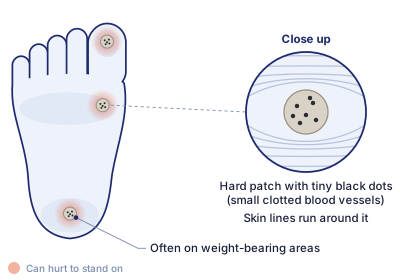
A verruca is a wart on the sole of the foot caused by the human papillomavirus (HPV). It usually looks like a hard patch with small black dots and can be painful to stand on. Many clear on their own over months or years, but stubborn verrucas are common in adults and respond best to professional treatment such as needling. Read more on our blog: verrucas, what they are and how to treat them.
Download the patient guidePDF · 2 pages · William Joyce, Consultant PodiatristWhat Is a Verruca?
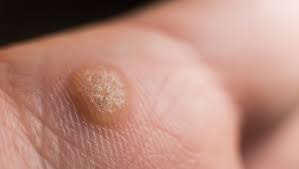
Verruca (plantar wart) — caused by the human papillomavirus (HPV)
A verruca is a viral wart found on the sole of the foot, caused by the human papillomavirus (HPV). They typically appear as hard, flat or raised patches — often with small black dots (thrombosed capillaries) visible at the surface — and frequently become painful when standing or walking as body weight compresses the lesion inward.
Verrucae are contagious and spread through direct contact with contaminated surfaces — swimming pools, gym changing rooms and communal showers are common transmission sites. The virus enters through small cuts or abrasions in the skin.
While some verrucae resolve spontaneously over months or years as the immune system clears the virus, many become persistent — particularly in adults — and benefit significantly from professional treatment, especially when causing pain, spreading to multiple sites or failing to respond to over-the-counter treatments.
Verruca Treatment Options
Verruca Needling (Falknor's Method)
Verruca needling is an advanced technique that punctures the verruca repeatedly under local anaesthetic, introducing the viral tissue into the deeper layers of the dermis. This triggers a targeted immune response — the body recognises the HPV virus and mounts a systemic attack that can clear not only the treated lesion but also verrucae elsewhere on the body. It is the most effective treatment for stubborn, long-standing or multiple verrucae and has the strongest evidence base of any podiatric verruca treatment.
For current pricing please visit our fees & pricing page.
Research: PubMed Central · British Journal of Dermatology 2017
Cryotherapy & Acid Treatments
For milder or earlier-stage verrucae, we offer cryotherapy (freezing with liquid nitrogen) and topical acids such as salicylic acid or monochloroacetic acid (MCA). These treatments work by destroying the infected tissue and stimulating a local immune response. They are less invasive than needling and are well suited to children, recent presentations, or patients who prefer to avoid local anaesthetic.
For current pricing please visit our fees & pricing page.
Why Patients Choose The Functional Podiatrist
Common Questions About Verruca Treatment
Is verruca needling painful?
We use local anaesthetic before the procedure, so discomfort during treatment is minimal. You may feel mild soreness for a few days afterwards — this is normal and a sign that the immune response is working.
How many needling sessions will I need?
Most patients require one session. Where the first treatment triggers a good immune response, outcomes are typically very positive. If the verruca has not fully resolved, a second session is usually carried out around 3 months later — this brings overall clearance rates up to 80–90% in the clinical literature. No treatment guarantees 100% clearance, but needling has the strongest evidence base for stubborn or long-standing verrucae.
Is needling better than acid or freezing?
For stubborn or long-standing verrucae, needling has a higher success rate. For newer, smaller or less established verrucae — particularly in children — cryotherapy or acid may be effective and less invasive. We will advise at your assessment which approach is most appropriate for your presentation.
Can children have these treatments?
Yes — we offer tailored treatment options for children and adults. Cryotherapy and acid treatments are generally preferred for younger patients. Needling requires local anaesthetic and is typically used in older children and adults. We will advise on the safest, most effective plan for your child's age and presentation.
How long does it take for a verruca to clear?
After needling, most verrucae resolve within approximately 3 months as the immune response builds. Acid and cryotherapy treatments typically require 3–6 sessions over several weeks before clearance is achieved. We review progress at each appointment and adjust the treatment plan accordingly.
Can I walk after verruca needling?
Yes — most patients walk out of the appointment comfortably. The local anaesthetic will wear off within a few hours, after which some tenderness is normal for 2–3 days. We provide aftercare guidance at the appointment.
Do I need a referral?
No — you can book directly online or by phone without a GP referral.
Swift Microwave Therapy
Swift Microwave Therapy — Book with Levi
Swift uses low-dose microwave energy, delivered through a small probe to the skin, to treat the verruca. It does not involve needles or breaking the skin. Treatments are usually spaced around four weeks apart. Swift is available at both our Richmond and Kensington clinics. For Swift treatment, please book with Levi Ferris, who will assess whether it suits you before you start.
Book Swift with Levi in Richmond · Book Swift with Levi in Kensington — choose Levi Ferris when booking. See our fees & insurance page for all prices.