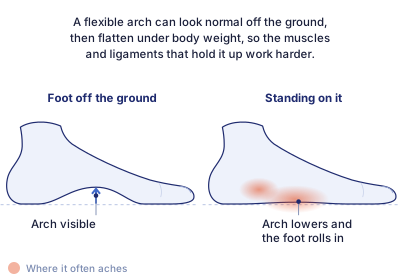
Hypermobile feet have joints that move further than average. Many people never have symptoms, but for others the extra movement means muscles and ligaments work harder, leading to tired arches, foot or knee pain, early bunions or repeated ankle sprains. Treatment focuses on strength, support and pacing rather than restricting movement.
Download the patient guidePDF · 2 pages · William Joyce, Consultant PodiatristHypermobility describes joints that move beyond the normal range of motion. Some people are naturally flexible and experience no symptoms. However, others develop pain, instability or fatigue because the muscles and ligaments must work harder to control joint movement.
In the feet and lower limbs, hypermobility can influence how the arch absorbs load, how the foot pushes off during walking and running, and how forces travel through the ankle, knee and hip. Many patients with persistent foot or knee pain have an underlying element of joint hypermobility affecting their biomechanics.
The foot contains 33 joints and plays a key role in absorbing load and transferring forces during walking and running. In people with hypermobility, the arch and midfoot may be more flexible, which can lead to increased strain on surrounding tissues.
Hypermobility can contribute to several common lower limb conditions due to increased movement and reduced joint stability. If you experience pain in multiple areas, hypermobility may be influencing how your body manages load.
A biomechanical and musculoskeletal assessment helps determine whether hypermobility is influencing your symptoms. This includes a full clinical history alongside evaluation of the foot, lower limb and movement patterns.
Treatment focuses on improving joint stability and load tolerance rather than restricting movement completely. The plan is tailored to your diagnosis, activity level, and goals.
If you experience recurring foot pain, knee pain, bunions developing early, or frequent ankle sprains, a biomechanical assessment may help identify whether hypermobility is contributing to your symptoms.
Early assessment helps prevent the cycle of partial recovery and re-injury that is common with unmanaged hypermobility. Don't wait for symptoms to escalate — addressing the underlying biomechanical contributors leads to faster, more lasting results.